Chargebacks FAQ
Last updated: Sep 17, 2026, 3:22 PM
Answers to the most common chargeback questions for Toast restaurants: how the process works, where to find chargebacks, notifications, fees, and disputes.
- Understanding Chargebacks and Toast's Role
- Finding and Reviewing Your Chargebacks
- Disputing a Chargeback
- Chargeback Notifications
- Chargeback Explanation Generator (AI)
- Chargeback Fees
- Reason Codes and Card Network Rules
- Preventing Future Chargebacks
- Frequently Asked Questions
- Related Articles
Understanding Chargebacks and Toast's Role
What is a chargeback?
A chargeback is a forced reversal of funds that starts when a cardholder contacts their card issuer and files a complaint about one or more transactions on their statement. The issuing bank places a hold on the funds, debits the amount from your bank account, and asks for documentation through Toast so you can dispute it.
For a fuller explanation of how the process works end to end, see What are chargebacks?
Also asked as:
-
- What does it mean when I get a chargeback?
- We just got notified of chargebacks from Toast, what does that mean?
How does the chargeback process work, and what is Toast's role?
The chargeback process is initiated by a cardholder, and Toast's role is limited to relaying information and documentation between you and the cardholder's issuing bank. After you submit documentation through the Chargeback Challenger, Toast relays it to the issuing bank, which solely decides whether you win or lose the dispute. Toast has no involvement in or influence on that decision and is not told the reasoning behind the result.
What can Toast do?
Toast is responsible for sending you chargeback notifications and giving you a way to dispute them through the Chargeback Challenger; it does not decide the outcome. Chargeback notifications and receipts are also stored in Toast Web for your reference. Once your documentation is submitted, the cardholder's issuing bank is the sole decision-maker, and Toast is not informed of the reasoning behind the result.
Can Toast Customer Care act on my behalf during or after a dispute?
Toast Customer Care can offer guidance with the dispute process but cannot contact the issuing bank or influence its timeframe or decision. The outcome and timing rest entirely with the cardholder's issuing bank.
Finding and Reviewing Your Chargebacks
Where do I find my chargebacks in Toast Web?
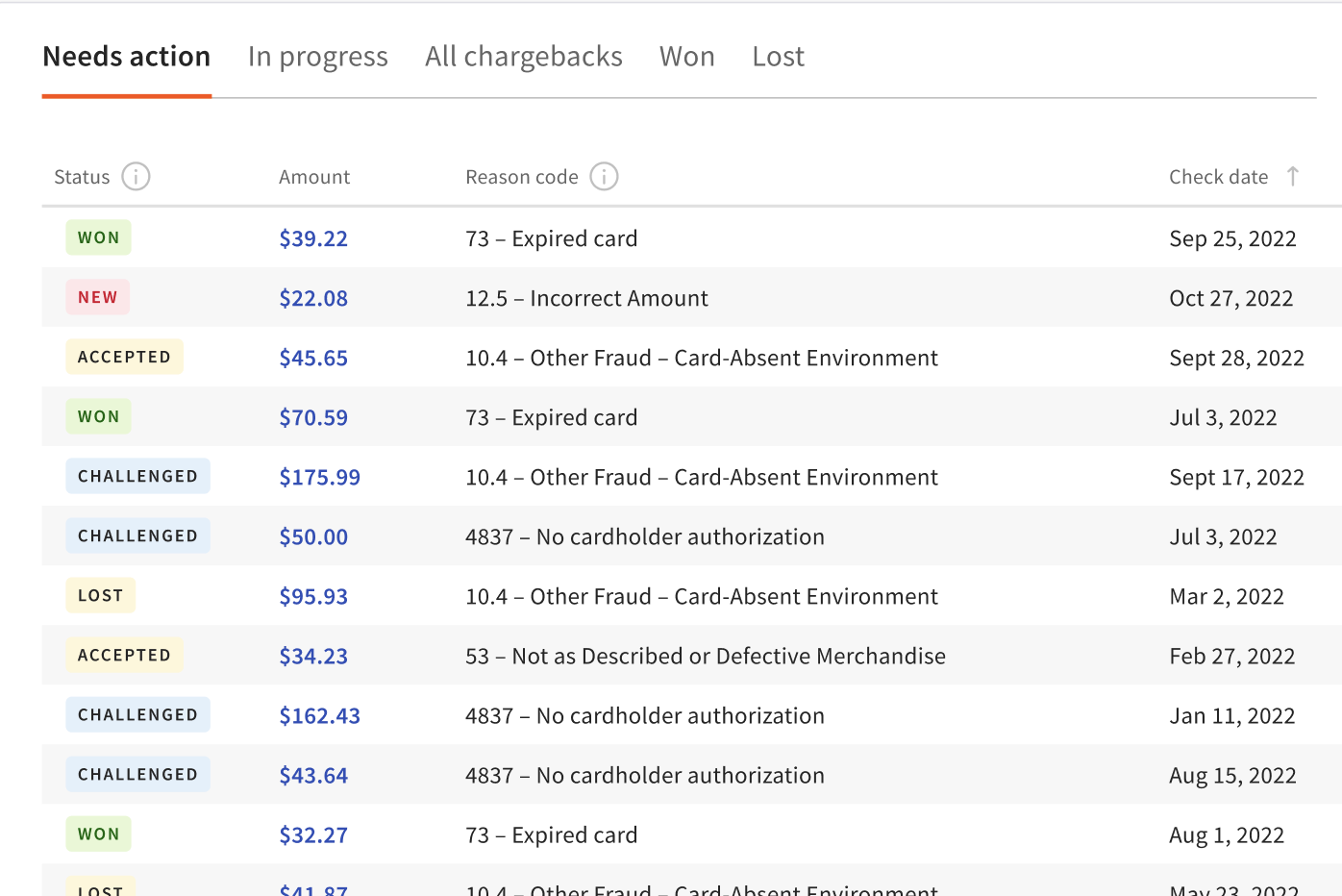
To find your chargebacks, navigate to Toast Web > Reports > Payments > Chargebacks, or open the Chargeback Challenger dashboard directly. The dashboard lists your chargebacks and can be filtered by status or date.
Note: To view and take action on chargebacks, you need manager-level access in Toast Web. If you open a chargeback link and see a message that someone needs to unlock it for you, see "Why does a chargeback say someone needs to unlock it for me?" below.
Also asked as:
-
- Where do I find chargebacks?
- Where can I see my chargebacks?
- How do I review a chargeback?
How do I check the status of a chargeback dispute?
To check the status of a chargeback dispute, view it on your Chargeback Challenger dashboard, or navigate to Toast Web > Reports > Payments > Chargebacks and then click Chargeback Challenger on the top, righthand side of the page. The status column shows where each chargeback stands.
For full status definitions and the step-by-step review process, see Handle and Review Guest Chargebacks in Toast Web.
How do I find both transactions for a Duplicate Processing chargeback?
To find both transactions for a Duplicate Processing chargeback, search the last four digits of the credit card used so you can locate every transaction paid with that card. For these chargebacks, the cardholder believes they were charged twice for the same transaction, so including the itemized receipts from every transaction the card paid for is a critical part of the dispute. Failing to include them often results in a denied dispute.
How can I find the check a chargeback notification refers to?
To find the check a chargeback notification refers to, use either of these methods:
-
- Open the Chargeback Challenger dashboard and filter your chargebacks by status or date.
- Use the receipt link in the chargeback notification email, which opens the digital receipt after you log in to Toast Web. To search manually instead, find the Draft/Ticket # on your notification, navigate to the Find Checks tool, open the Find by ID tab, enter the draft number in the Payment Reference field, and select Search.
Disputing a Chargeback
How do I dispute or fight a chargeback?
To dispute a chargeback, open it in the Chargeback Challenger, enter an explanation, upload your supporting documents, and submit the challenge before the deadline. The cardholder's issuing bank then reviews your evidence and decides the outcome. *Once your dispute has been submitted, no further information can be added to your dispute. So it's important to ensure that you get all of the information you'd like to submit uploaded before submitting your dispute.
For the full step-by-step process, including how to accept a chargeback and what each status means, see Handle and Review Guest Chargebacks in Toast Web.
Also asked as:
-
- How do I fight a chargeback?
- How do I challenge a chargeback?
- Where do I dispute a chargeback?
How long do I have to dispute a chargeback?
You have 15 calendar days from the report date of the chargeback notification to dispute it. The report date is the date Toast receives the notification from the card issuer. Each chargeback also shows its own deadline on the Chargeback Challenger dashboard, so check there for the exact date. If you do not respond by the deadline, the dispute is automatically ruled in the cardholder's favor.
When is the chargeback amount taken from my account?
The chargeback amount is debited directly from your bank account within two to four calendar days after Toast receives the chargeback notification, and it is automatically taken from that day's deposit. You must dispute the chargeback to have a chance of recovering those funds.
Why was my chargeback dispute unsuccessful?
A chargeback dispute is unsuccessful when the cardholder's issuing bank rules in the cardholder's favor, which is a decision Toast does not make or influence. Even with a legitimate signed receipt, the bank can decide against you, and Toast is not told the reasoning behind the result. The quality and completeness of your submitted evidence can impact the outcome, and certain reason codes are very difficult to win (see "Reason Codes and Card Network Rules" below).
Also asked as:
-
- Why did I lose my chargeback?
- Why was my challenge unsuccessful even with a signed receipt?
Chargeback Notifications
How do I change who receives chargeback notifications?
To change who receives chargeback notifications, update your restaurant's financial contact in Toast Web. Chargeback notifications are sent to the financial contact listed in your communication preferences, and you can list more than one person. For step-by-step instructions, see Optimize Communication Preferences and Add or Update Financial Contact Email.
Also asked as:
-
- How do I update who gets chargeback emails?
- How do I add someone to chargeback notifications?
- How do I change the email list for chargebacks?
What if I missed a dispute deadline because I didn't receive a notification?
If you missed a dispute deadline, the chargeback is automatically ruled in the cardholder's favor and the funds are not returned. Chargeback notifications are sent to your restaurant's financial contact and can get lost in a busy inbox, so it is best to check your Chargeback Challenger dashboard regularly to stay ahead of new chargebacks and track existing disputes.
How do I unsubscribe from chargeback notification emails?
To unsubscribe from chargeback notification emails, select Unsubscribe from chargeback emails for all locations at the bottom of any chargeback email.
Some employees are receiving chargeback notifications when they shouldn't be. How do I fix this?
If employees are receiving chargeback notifications when they are not listed on your Toast Web Communication preferences page, contact Toast Customer Care for help. You can also confirm who is listed by reviewing your communication preferences, as described in Optimize Communication Preferences.
Chargeback Explanation Generator (AI)
What is the chargeback explanation generator?
The chargeback explanation generator is a Toast AI feature that drafts a suggested explanation for you to use in your chargeback dispute. It gives you a starting point based on data available through the Chargeback Challenger, and you will see the suggested text in the Explanation box within the dispute workflow. To learn more, see Handle and Review Guest Chargebacks in Toast Web.
Why did I lose the dispute when I used the suggested explanation?
Losing a dispute after using the suggested explanation can happen because the AI-generated text is a starting point, not a guarantee of success. Each dispute is unique, and many factors affect the outcome, so it is important to review and customize the explanation and include all necessary supporting documents before you submit.
Is Toast liable for my loss because I used the suggested explanation?
No, Toast is not liable for the outcome of your chargeback dispute when you use the suggested explanation. The suggestion is a tool to assist you, and you are responsible for reviewing it, modifying it as needed, verifying its accuracy, and making sure it fits your specific case.
What should I do if the generated explanation is inaccurate?
If the generated explanation is inaccurate, use the feedback form at the end of the chargeback challenge process to report inaccuracies or inconsistencies.
How is my information processed when I use the chargeback explanation generator?
When you use the chargeback explanation generator, your data inputs and the generated outputs may be used to train Toast's AI model. All information is processed in accordance with Toast's Privacy Statement.
Chargeback Fees
Are there fees for processing chargebacks?
Yes, there is a $15 fee to process each chargeback notification. This fee is charged regardless of whether you dispute the chargeback, and regardless of whether you win or lose the dispute.
Am I charged the $15 fee if I win the dispute?
Yes, the $15 processing fee applies even if you win the dispute. The fee covers processing the chargeback notification itself, so it is charged regardless of the outcome.
Also asked as:
-
- Do I still pay the fee if I win?
- Is the $15 fee charged when I fight a chargeback?
What does the chargeback processing fee cover?
The chargeback processing fee covers the cost of transmitting chargeback data, the costs associated with the chargeback itself, and coverage against chargeback exposure to Toast for credit card processing. The fee is not waived unless the chargeback resulted from a known Toast processing outage or another Toast issue.
Why does Toast charge a processing fee when my previous processor didn't?
Toast charges a transparent, itemized chargeback fee, whereas a previous processor likely built similar costs into other charges. Those costs were often bundled into an overall processing fee, a monthly fee, or a product subscription rather than shown as a separate line item.
Why did Toast debit my account instead of deducting from my usual daily deposit?
Toast debited your account instead of your daily deposit because your total refunds and chargebacks for that day exceeded that day's total sales. This is a rare occurrence.
Reason Codes and Card Network Rules
What are the risks of disputing authorization and chip liability shift chargebacks?
The main risk is an additional fee: card networks may charge up to $500 for disputing chargebacks they consider nearly indisputable. Card issuers and networks treat certain reason codes as well supported by the issuing bank's data, so for these codes it is often best to avoid disputing a chargeback you are unlikely to win. Mastercard treats the following codes as generally valid and very difficult to dispute:
-
- Reason code 4808 – Authorization-Related Disputes
- Reason code 4870 – Chip Liability Shift
- Reason code 4871 – Chip and PIN Liability Shift
What are the reason codes for Duplicate Processing chargebacks?
The Duplicate Processing reason codes vary by card network, as shown below.
| Card Network | Reason Code |
| Visa | 12.6.1 – Duplicate Processing |
| Mastercard | 4834 – Duplicate Processing |
| Discover | DP – Duplicate Processing |
| Amex | P08 – Duplicate Charge |
Which chargebacks are EMV-related?
The EMV-related chargebacks are the reason codes tied to chip (EMV) liability, as shown below. EMV stands for Europay, Mastercard, and Visa, the global chip-card standard.
| Card Network | Reason Code |
| Visa | 10.1 EMV Liability Shift; 10.2 EMV Liability Shift Non-Counterfeit Fraud |
| Mastercard | 4870 – Chip Liability Shift; 4871 – Chip and PIN Liability Shift |
| Discover | UA05 – Fraud Chip Card Counterfeit; 4871 – Fraud Chip and PIN Transaction |
| Amex | F30 – EMV Counterfeit Transaction; F31 – EMV Lost or Stolen |
Note: Mastercard applies a 20% tip tolerance when the card is not present. As of October 13th, 2017, card-not-present Mastercard payments have chargeback protection as long as the tip is 20% or less.
What do I do if the reason code is not correct?
If the reason code is not correct, it is still worth responding to the chargeback and pointing out the incorrect code, even though the issuing bank sets these codes and rarely changes them once submitted.
Why are Amex chargebacks different?
Amex chargebacks are different because American Express does not have an arbitration process, unlike Visa or Mastercard. Dispute timeframes can also vary depending on the chargeback reason code.
How should I handle a chargeback on a gift card or prepaid card?
A chargeback on a gift card or prepaid card follows a different set of steps than one on a credit card, and it helps to understand the tip limits these cards carry. Many prepaid cards only allow a tip of up to 20% of the authorization amount.
Preventing Future Chargebacks
How can I help prevent fraudulent chargebacks?
To help prevent fraudulent chargebacks, process card-present payments with the more secure EMV (chip) by having guests present payment at pickup whenever your workflow allows. You can also ask for an ID that matches the name on the credit card, or ask the guest to present the card itself at pickup. Toast cannot block specific credit card numbers.
For team training and more prevention steps, see Train Your Team on Preventing Fraudulent Future Chargebacks. If you believe a chargeback involves fraud, Train Your Team on Preventing Fraudulent Future Chargebacks walks through next steps.
How can I reduce chargebacks on online and card-not-present orders?
To reduce chargebacks on online and card-not-present orders, increase your card-not-present protection by capturing verification details such as the billing ZIP code. Card-not-present transactions, including many online and gift card orders, carry more chargeback risk than chip transactions. For details, see Increase Chargeback Protection for Card-Not-Present Transactions.
Frequently Asked Questions
Why does a chargeback say someone needs to unlock it for me?
A chargeback that says someone needs to unlock it for you is showing a permissions message, which means your account is missing the access needed to open the Chargeback Challenger. To view and act on chargebacks, you need 3.0 Manager access in Toast Web, and that permission must be on the exact employee profile you use to log in. If you confirm you have 3.0 Manager access on the correct profile and the chargeback link still says someone needs to unlock it for you, contact Toast Customer Care.
Also asked as:
-
- Why can't I access a chargeback when I'm an admin?
- Why does my chargeback link say to contact my admin?
- What permission do I need to view or dispute a chargeback?
Can I add documents or edit my dispute after I submit it?
You cannot edit or amend a dispute after you submit it, so include every supporting document and a complete explanation before you select submit. Card network policies usually restrict resubmission, which is why all evidence must be in place at submission. If you have already submitted and have critical new evidence, contact Toast Customer Care.
What is a retrieval request, and is it the same as a chargeback?
A retrieval request is not the same as a chargeback; it is a request from the cardholder's bank for more information about a transaction, often before any chargeback is filed. You can view and respond to retrieval requests in the same place as chargebacks. For status definitions, see Handle and Review Guest Chargebacks in Toast Web.
What file types can I upload to support a chargeback challenge?
You can upload JPG, PDF, PNG, or TIFF files to support a chargeback challenge. You can upload up to 10 files, with a maximum size of 1 MB per file.
Why don't my Amex chargebacks appear in the Chargeback Challenger?
If your Amex chargebacks are missing from the Chargeback Challenger, see Amex Chargebacks Missing from Chargeback Challenger for the current guidance on this scenario.
Related Articles
- Handle and Review Guest Chargebacks in Toast Web
- What are chargebacks?
- Locate a Chargeback
- Train Your Team on Preventing Fraudulent Future Chargebacks
- Chargebacks Report Overview