Understand Marketplace Facilitator Laws
Last updated: Jun 17, 2026, 9:03 AM
- Marketplace Facilitator Tax Basics
- Toast Marketplace Facilitator Tax
- Is Toast classified as a marketplace facilitator?
- Where is Toast classified as a marketplace facilitator?
- Does Toast collect and remit all sales taxes?
- Are any transactions outside of the Toast Local app and Toast Local impacted by marketplace facilitator laws?
- How can I view taxes collected and remitted by Toast on orders where Toast is classified as a marketplace facilitator?
- Why do tax amounts for marketplace facilitator orders look different from other orders?
- Can I modify orders where Toast is classified as a marketplace facilitator?
- Can I refund or void orders where Toast is classified as a marketplace facilitator?
- Third-Party Marketplace Facilitators
- Which third-party ordering partners are considered marketplace facilitators?
- How can I view taxes reported and remitted by third-party marketplace facilitators?
- Where can I find more information about how third-party providers support marketplace facilitator tax laws in their platform?
- If my restaurant uses multiple third-party marketplace facilitator partners, how will it show in Toast reports?
- For third-party “Remitted by Restaurant” tax amounts, how do I know which tax authorities to remit taxes to?
- My restaurant uses a different partner (such as Chowly or Checkmate) to receive orders from Uber Eats, Grubhub, and DoorDash - Are these orders still considered marketplace facilitator orders, and how will they be represented in Toast?
- Can I modify orders from third-party marketplace facilitators?
- How do I handle refunds on orders coming from my direct integration?
Marketplace Facilitator Tax Basics
What is a marketplace facilitator?
A marketplace facilitator is typically defined as a person or entity that contracts with third-party sellers to facilitate the sale of certain tangible property, digital goods, and/or services by those third-party sellers through a marketplace operated by that person or entity.
Given the way marketplace facilitators are defined in certain states' tax laws, Toast and other third-party providers like Uber Eats, DoorDash, and Grubhub may be considered marketplace facilitators for the purposes of third-party sales facilitated through such provider’s relevant marketplace.
How do marketplace facilitator laws impact tax?
In some jurisdictions, marketplace facilitator laws shift sales tax collection and remittance obligations from the third-party seller (in this case, a Toast restaurant) to the marketplace facilitator. In these jurisdictions, the marketplace facilitator is responsible for collecting and remitting tax on sales made through their platform.
As an example, for orders where Toast is classified as a marketplace facilitator under applicable laws, Toast is responsible for collecting and remitting tax to the appropriate taxing authority.
It may be advisable for you to consult with a professional such as a lawyer, accountant, or business advisor for advice specific to your situation.
How do I know if marketplace facilitator laws affect my restaurant?
Information about marketplace facilitator laws can be found on most state Department of Revenue sites.
In certain jurisdictions the Toast Local app (formerly Toast Takeout), Toast Local, and some third-party ordering partners are classified as marketplace facilitators.
- To find out whether Toast is classified as a marketplace facilitator in your state, please read the Where is Toast classified as a marketplace facilitator? section below
- To find out whether you integrate with any third-party ordering partners that are classified as a marketplace facilitator, please read the Which third-party ordering partners are considered marketplace facilitators? section below.
Toast Marketplace Facilitator Tax
Is Toast classified as a marketplace facilitator?
Toast is classified as a marketplace facilitator for orders originating from the Toast Local app and Toast Local in applicable jurisdictions.
Where is Toast classified as a marketplace facilitator?
Toast is registered to collect and remit taxes as a marketplace facilitator in the following U.S. states:
| State | Effective Date of Toast Remittance |
| Alabama | April 7, 2025 |
| Arkansas | December 19, 2024 |
| Colorado | May 1, 2025 |
| Connecticut | March 10, 2025 |
| Washington, D.C. | March 3, 2025 |
| Georgia | April 7, 2025 |
| Hawaii | February 10, 2025 |
| Idaho | March 25, 2025 |
| Illinois | May 1, 2025 |
| Indiana | March 3, 2025 |
| Iowa | February 24, 2025 |
| Kansas | April 7, 2025 |
| Kentucky | April 14, 2025 |
| Maine | December 12, 2024 |
| Michigan | March 17, 2025 |
| Minnesota | April 14, 2025 |
| Nebraska | February 18, 2025 |
| Nevada | March 3, 2025 |
| New Mexico | February 18, 2025 |
| North Carolina | February 24, 2025 |
| North Dakota | March 24, 2025 |
| Ohio | March 10, 2025 |
| Pennsylvania | April 21, 2025 |
| Rhode Island | February 10, 2025 |
| South Carolina | April 14, 2025 |
| South Dakota | February 3, 2025 |
| Vermont | March 10, 2025 |
| Virginia | February 18, 2025 |
| Washington | March 17, 2025 |
| West Virginia | March 24, 2025 |
| Wisconsin | March 17, 2025 |
| Wyoming | February 3, 2025 |
Note: This list is subject to change as tax laws change.
Does Toast collect and remit all sales taxes?
Toast will collect and remit all applicable taxes on transactions facilitated through the Toast Local app and Toast Local in applicable jurisdictions.
In some local jurisdictions where Toast is unable to register to remit taxes, local taxes will be passed back to the restaurant to remit (i.e., alcohol and local food and beverage taxes). The passed-back taxes must be remitted by the restaurant to remain compliant with tax laws. The tax will be reflected on the Tax Report in Toast Web as “Paid by Customer.” Toast will still remit associated sales and use taxes to the State to remain compliant. Local Tax is passed back to restaurants in the following states: Arkansas, Georgia, Idaho, Illinois, Kansas, Kentucky, Minnesota, North Dakota, Pennsylvania, South Carolina, Virginia, West Virginia.
It may be advisable for you to consult with a professional such as a lawyer, accountant, or tax advisor for advice specific to your situation.
Note: This determination is subject to change.
Are any transactions outside of the Toast Local app and Toast Local impacted by marketplace facilitator laws?
Transactions through other Toast ordering platforms (such as POS, kiosk, Toast Online Ordering, and Toast Mobile Order & Pay®) are not subject to marketplace facilitator laws. Tax collection and remittance for transactions completed outside of the Toast Local app and Toast Local remain the responsibility of the restaurant.
Certain third-party ordering providers, such as DoorDash, Grubhub, and Uber Eats are also classified as marketplace facilitators. For more information on marketplace facilitator tax for these third-party providers, please refer to the Third-Party Marketplace Facilitators section below, or reach out to them directly.
It may be advisable for you to consult with a professional such as a lawyer, accountant, or tax advisor for advice specific to your situation
How can I view taxes collected and remitted by Toast on orders where Toast is classified as a marketplace facilitator?
To view Toast marketplace facilitator tax amounts, navigate to the Sales Summary report in Toast Web, and find the Tax summary tile. This report will show three lines applicable to Toast marketplace facilitator taxes:
- Toast marketplace facilitator tax: The total amount of tax that is collected by Toast on orders where Toast is classified as a marketplace facilitator
- Remitted by Toast: The total amount of tax that Toast is responsible for remitting to the appropriate taxing authorities under applicable law.
- Remitted by Restaurant: The total amount of tax collected by Toast on orders where Toast is classified as a marketplace facilitator that the restaurant is responsible for remitting to the appropriate tax authorities.
- Note: This line will not be shown if the Toast is responsible for remitting all taxes. It will only be shown if the taxable amount is greater than $0.00.
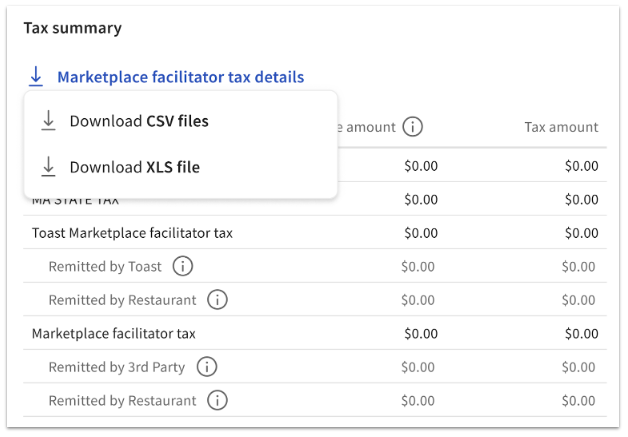
You may also export a report that provides transaction-level tax information for all orders where Toast is classified as a marketplace facilitator.
Why do tax amounts for marketplace facilitator orders look different from other orders?
To comply with marketplace facilitator tax laws, Toast is required to independently determine the tax rates applicable to items sold for orders where Toast is classified as a marketplace facilitator. For these orders only, the tax rates configured by you in Toast’s backend are not used to calculate tax amounts. Instead, Toast uses an automated system to assign applicable tax rates to items sold, which may differ from the tax rates configured by you.
If you believe that Toast has incorrectly assigned tax rates to items sold on marketplace facilitator orders, please contact Toast Support for assistance.
Note: You, the merchant, are responsible for configuring tax rates per state and local tax regulations for all orders where Toast is not classified as a marketplace facilitator. Tax rates must be configured and assigned in order to be calculated and collected with these orders. Check your local regulations when setting up or modifying your tax rates.
Can I modify orders where Toast is classified as a marketplace facilitator?
Yes, you can modify Toast marketplace facilitator orders on the POS. Third-party ordering marketplace facilitator orders like from DoorDash and Uber Eats will continue to be locked on the POS and cannot be edited.
When editing things on the order that do not change the price (for example changing a server), you can continue to make these changes as you would on any order. The order’s tax will continue to be tagged as marketplace facilitator tax in your reporting.
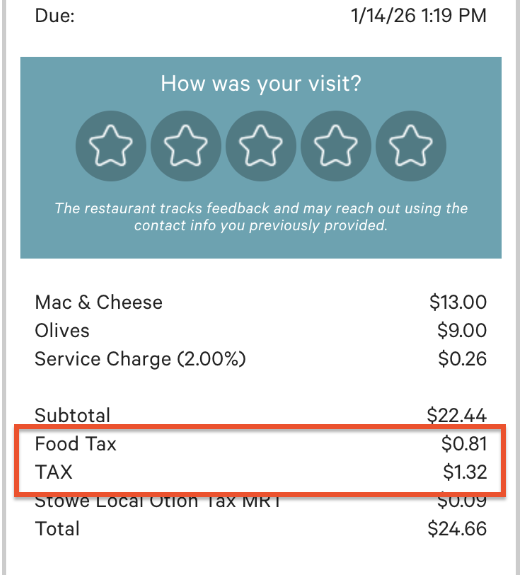
When editing things on the order that do change the price (for example removing or adding an item), the new items will continue to be tagged as marketplace facilitator tax in your reporting. This may result in multiple tax line items on the receipt as seen in the image below reflecting the original tax charged, and the tax charged for the updated item.
Can I refund or void orders where Toast is classified as a marketplace facilitator?
Yes, you can refund or void orders where Toast is classified as a marketplace facilitator with some exceptions.
The table below describes which refund and void types are allowed for orders where Toast is classified as a marketplace facilitator.
| Allowed | NOT Allowed |
|
|
Third-Party Marketplace Facilitators
Third-party integration providers may be classified as marketplace facilitators. However, Toast doesn't make independent determinations as to which third-party providers will be classified as marketplace facilitators. It is the responsibility of such third-party providers to determine whether they are classified as a marketplace facilitator under applicable law.
Toast supports the ability for these third-party providers to comply with marketplace facilitator laws, and provides basic reporting to your restaurant to understand the tax amounts collected by third-party marketplace facilitator providers.
Back to top
Which third-party ordering partners are considered marketplace facilitators?
Toast doesn't make independent determinations as to which third-party providers will be classified as marketplace facilitators under applicable law - this is the responsibility of such third-party providers.
At this time, only Uber Eats, DoorDash, and Grubhub inform Toast of any sales tax amounts they remit to restaurants.
If you have questions about how other online ordering providers might be handling compliance with the marketplace facilitator tax laws, please work with those providers directly.
To view a list of third-party integrations your restaurant uses, navigate to Integrations > Browse & purchase integrations > Manage integrations in Toast Web.
How can I view taxes reported and remitted by third-party marketplace facilitators?
To view third-party marketplace facilitator tax amounts, navigate to the Sales Summary report in Toast Web, and find the Tax summary tile. This report will show three lines applicable to third-party marketplace facilitator taxes:
- Marketplace facilitator tax: The total amount of tax that is collected by third-party marketplace facilitator providers
- Remitted by 3rd Party: The total amount of tax that the third-party providers are responsible for remitting to the appropriate taxing authorities under applicable law.
- Remitted by Restaurant: The total amount of tax collected by third-party marketplace facilitator providers that the restaurant is responsible for remitting to the appropriate tax authorities.
- Note: This line will not be shown if the third-party provider is responsible for remitting all taxes. It will only be shown if the taxable amount is greater than $0.00.
Toast is not responsible for determining tax amounts for third-party marketplace facilitator orders. Tax determination for third-party marketplace facilitator orders is done by the third-party provider and passed to Toast for reporting purposes. If there are issues with the tax amounts collected by a third-party provider, please reach out to them directly.
Where can I find more information about how third-party providers support marketplace facilitator tax laws in their platform?
To learn more about how third-party providers support marketplace facilitator taxes, please see the articles published by each of these companies, linked below:
- DoorDash Marketplace Facilitator FAQ (external link)
- Uber Eats Marketplace Facilitator FAQ (external link)
If you have any questions, please reach out to the third-party marketplace provider directly for more information.
Publication of third-party links does not constitute an endorsement. Toast does not warrant the accuracy or completeness of any information, text, graphics, links, or other items contained within this content.
If my restaurant uses multiple third-party marketplace facilitator partners, how will it show in Toast reports?
If your restaurant uses multiple third-party marketplace facilitator providers, the total tax amounts shown in the Sales Summary are aggregated into the same line.
For more information about marketplace facilitator taxes collected by individual third-party providers, please visit your third-party’s website or reach out to them directly.
For third-party “Remitted by Restaurant” tax amounts, how do I know which tax authorities to remit taxes to?
Please visit your third-party provider’s website to determine how and to whom these tax amounts should be paid. If you have any additional questions about this field, please contact your third-party ordering partner directly.
This content is provided for general informational purposes only and is not intended as legal, tax, HR, or other professional advice. Please contact an attorney, applicable partner, or tax professional for specific advice based on your unique circumstances
My restaurant uses a different partner (such as Chowly or Checkmate) to receive orders from Uber Eats, Grubhub, and DoorDash - Are these orders still considered marketplace facilitator orders, and how will they be represented in Toast?
Yes, orders from Uber Eats, Grubhub, and DoorDash, facilitated by another third-party partner are still classified as marketplace facilitator orders.
Toast supports the ability for other third-party partners that facilitate orders through Uber Eats, DoorDash, and Grubhub to be represented in Toast reporting in the same way as a direct integration with these third-party providers. However, this requires updates to the partner configuration by Toast and must be requested by the third party.
Can I modify orders from third-party marketplace facilitators?
Modifications to orders from third-party marketplace facilitators are not allowed.
Third parties designated as marketplace facilitators determine and calculate taxes independently from Toast. Modifying these orders after they have reached the Toast system could result in price and tax calculation discrepancies. To prevent discrepancies and ensure reporting is consistent with what our partners have calculated, Toast does not allow these orders to be modified.
Modifications are any type of change to the order after it has been placed, such as adding or removing items, and including refunds.
- To process a refund, please contact the partner directly.
- To add items to an order, create a new order and take a new payment.
How do I handle refunds on orders coming from my direct integration?
Your guest must contact the partner directly to receive a refund on an order. Orders from these partners cannot be canceled or voided in Toast once they have been submitted by the guest.
Note: Uber Eats orders can be voided on Toast POS and will be reflected accurately in your Toast reporting, however you or the guest must still work with Uber Eats directly to receive a refund.
Back to top
This content is provided for general informational purposes only and is not intended as legal, tax, or other professional advice. Publication of third-party links does not constitute an endorsement. Toast does not warrant the accuracy or completeness of any information, text, graphics, links, or other items contained within this content. Toast does not guarantee you will achieve any specific results if you follow any advice herein. It may be advisable for you to consult with a professional such as a lawyer, accountant, or business advisor for advice specific to your situation.