Configure Modifier Display Options
Last updated: Sep 17, 2026, 1:24 PM
- Modifier Display Modes
- Vertical Mode
- Horizontal Mode
- Legacy Mode
- Legacy - Flatten Mode
- Consolidate Menu Items
- Consolidate Modifiers
- Change the Default Modifier Order
- Change the Default Modifier Visibility
- Manually Change the Order of Modifiers
- Group by Plate
Modifier Display Modes
There are many ways modifiers can be displayed on your POS. To choose the setting that's most appropriate to your restaurant, follow these steps.
- In Toast Web, navigate to Front of house > Order screen setup > UI options.
- Under the Order Screen section, there are four Modifier display mode options. Each mode is described in detail in this article. Select you desired mode.
- Save and publish your changes.
Vertical Mode for Modifier Display
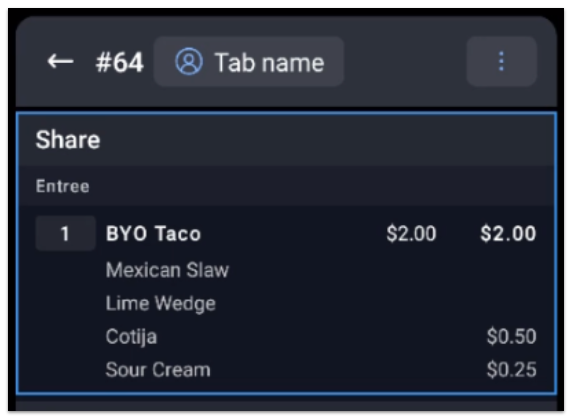
Vertical mode disregards the designed hierarchy and simply lists the options you select in the order you select, them regardless of price. In vertical mode, required modifiers will appear at the bottom. If all modifier groups are optional, then it will list your selections in the order you make them, even if some include additional cost and some are free.
In the example below, all BYO Taco add-ons are optional, and "Mexican Slaw" is a required side choice.
Horizontal Mode for Modifier Display
Horizontal mode will show options as a list, with free modifiers before modifiers with additional cost, and required modifiers before optional modifiers. Free and required modifier options are pushed to the front of the comma-separated list while additional cost modifiers are pushed to the bottom. The cost of these modifiers is summed in a single total.
In the example below:
- Pico de Gallo and Cotija are both ordered first, at an additional cost
- Mexican Slaw is required (side choice)
- Lime Wedge is free, so it's pushed near the front
Legacy Mode for Modifier Display
Legacy mode lists free modifiers before modifiers with additional cost, and required modifiers before optional modifiers.
In the example below:
- Mexican Slaw is a required modifier as a choice of side
- Lime Wedge and Salsa Verde are free and forced optional
- Cotija and Jalapeño Crema are forced optional and have an additional cost
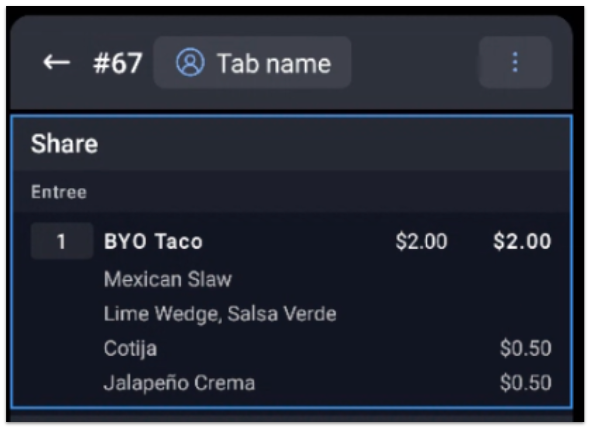
The free modifiers are pushed to the top, but will be listed in the order in which you select them. Mexican Slaw (a side choice) is required, Lime Wedge and Salsa Verde are forced optional, but both are free - so they are listed in the order they were selected.
The modifiers with additional cost are pushed to the bottom of the list, even if they're selected first. Within the group of modifiers with additional cost, they are treated the same as free modifiers and will be listed in the order you select them.
Legacy - Flatten Mode for Modifier Display
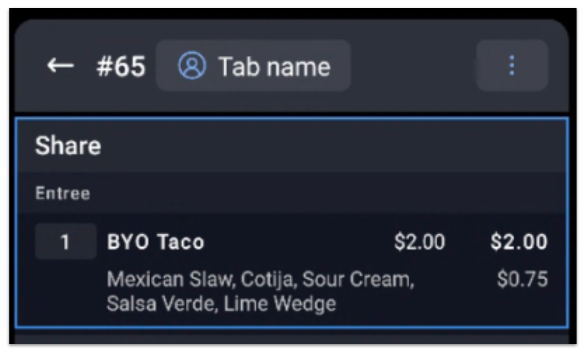
Legacy - Flatten mode will list the modifiers you select for an item separated by a comma. It's important to note that Legacy - Flatten mode doesn't use the same hierarchy as the legacy mode explained above. It will add up the cost of any additionally price modifiers into a single total below the item cost (if modifier cost is set to show separately).
In the example below:
- Mexican Slaw is a required modifier choice (side choice).
- Cotija is $0.50 extra.
- Sour Cream is $0.25 extra.
- Salsa Verde and Lime Wedge are free.
- All modifier upcharges are added together to total $0.75.
Consolidate Menu Items
This feature will present items ordered more than once on a single line if enabled. For example, if someone has ordered three cheeseburgers, the ticket will show "3x Cheeseburger" instead of showing each item on its own line. This also links to the Group by Plate setting, which can be found in kitchen setup.
To enable this option:
- Navigate to Front of house > Order screen setup > UI options.
- Toggle the Consolidate menu items setting to the On position.
- Save and publish your changes.
Consolidate Modifiers
This setting is used to group together any identical modifiers that are listed under the same item.
For example, if someone orders a half dozen donuts, the parent item would be "1 Half Dozen Donuts" and the consolidated modifiers would show as "2x Chocolate, 3x Vanilla, 1x Strawberry."
To enable this feature:
- Navigate to Front of house > Order screen setup > UI options.
- Toggle the Consolidate modifiers setting to the On position.
- Save and publish your changes.
Once enabled, this feature will affect the display of modifiers in the following areas:
- POS order view / split checks
- Printed kitchen tickets / KDS / All Day Display
- Customer receipts
- Guest-Facing Display
Note:
- Consolidate Items must also be selected under UI Options for modifier consolidation to work correctly.
- Setting up duplicate modifiers for your menu will allow your guests to select multiple quantities of the same modifier. For more information on duplicate modifiers, check out this Support Center article, Set Up and Use Duplicate Modifier Selections.
Change the Default Modifier Order
- Navigate to Front of house > Order screen setup > UI options.
- For the Modifier group sorting setting, select your desired format:
- Display in order modifiers were added - This will display each modifier on the order based on exactly how they were entered by the staff member.
- Display in order modifiers are listed in their modifier group - This will rearrange the modifiers added to the order to match the exact sequence of modifier groups that are listed in your menu setup.
- Save and publish your changes.

In the example above, based on the sequence of modifier groups listed, the system will ensure that the Taco Add-Ons option that is selected by the staffer is always listed at the top of the order, followed by the Side Choice.
In order to utilize this function, you'll need to select either Vertical or Horizontal modifier display mode.
Back to top
Change the Default Modifier Visibility
In order to improve order clarity for your staff and guests alike, if you use default modifiers in your restaurant, you can decide if you would like to show the default modifiers for a menu item.
When enabled, this setting always shows the default modifiers for a menu item. When not enabled, default modifiers are shown only when they are removed (for example, “NO tomato”). This only applies to default modifier groups where more than one modifier can be selected. Default modifiers, where only one can be selected, are always shown.
These settings apply to all devices, receipts, kitchen tickets, and online ordering pages. To configure this:
- In Toast Web, navigate to Front of house > Order screen setup > UI options.
- In the Order screen section, navigate to Default Modifier Options and select one of the default modifier options for your location:
- Show only included default modifiers (e.g, "ketchup)
- Show only removed default modifiers (e.g., "NO ketchup")
- Show both removed and included default modifiers (e.g., "ketchup" and "NO mustard")
Note: If a default modifier has an additional cost, it will always display on the order and receipt regardless of which option you choose above — this setting only affects whether free default modifiers are shown.
- Save and publish all changes.
Manually Change the Order of Modifiers
It's important for restaurants to be able to control the order that modifiers appear on the POS and in the kitchen. Modifiers can be manually placed in order of preference, regardless of whether they're required or optional.
Note that although the order of the modifiers on your screen and kitchen tickets will appear according to your selections, required modifier groups will always be prompted first in the POS workflow. This means that if you'd like to enter optional modifiers before required modifiers, you'll need to manually select the optional modifier after being prompted for the required modifier. In other words, manually changing the order of modifiers simply changes the order that modifiers are arranged on a ticket, not the order they are prompted in.
To learn how to change the modifier group display ordering for modifier groups, check out this Support Center article, Manage Modifier Group Display Order.
Back to top
Group by Plate
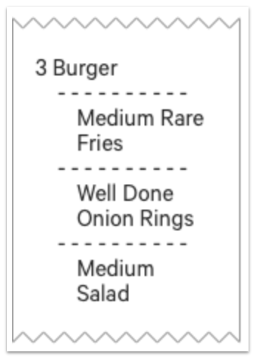
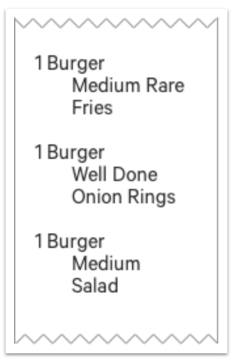
The Group by Plate setting will combine identical items together on one printed kitchen ticket. Modifiers (for each plate) will follow in groups separated by dashed lines. It's a great feature if you have bulk orders of the same menu item with varied sides. Group by plate will also create shorter tickets through the consolidation method. This is different than the menu item consolidation feature.
| Group by Plate Enabled | Group by Plate Disabled |
 |  |
To enable this feature in Toast Web, follow these steps:
- Navigate to Kitchen > Printers, tickets, & KDS devices > Kitchen.
- In the Printed Tickets section, for the the Group by Plate setting, select Yes.
- Save and publish your changes.