Toast Payroll: No Tax on Tips and/or Overtime
Last updated: Oct 14, 2026, 5:16 PM
Read this guide for information on the "no taxes on tips" and "no taxes on overtime" provisions in One Big Beautiful Bill Act.
|
One Big Beautiful Bill Summary
The One Big Beautiful Bill Act became law on July 4th, 2025 and Toast Payroll has made changes in response to the new law. In general, you should continue to confirm the settings in your system and configure it based on compliance with regulations.
The One Big Beautiful Bill Act has "no taxes on tips" and "no taxes on overtime" provisions. This means individual employee deductions are available for eligible employees when they file their 2025 personal income tax return in 2026. To aid in this personal tax filing, Toast Payroll has indicated these tip amounts and overtime premium amounts on employee profiles in Toast Payroll under My Profile > Taxes & Documents > Year End Documents. (If you do not see My Profile on the left side of the screen, select Payroll from the Toast Web navigation rail on the left to make the Toast Payroll navigation rail appear.)
If an employee believes their amounts to be incorrect or they have questions on how to use these numbers for tax filing, reach out to an accountant or tax professional. Toast is unable to assist employees with filing taxes.
"No Tax on Overtime"
Overtime Premium
Per One Big Beautiful Bill, "no tax on overtime" allows employees to claim overtime premium amounts earned per federally-mandated overtime laws in their personal tax deductions. To assist employees in finding this amount, Toast Payroll has estimated and displayed overtime premium amounts.*
Employees can log into Toast Payroll and navigate to My Profile > Taxes & Documents > Year End Documents. (If you do not see My Profile on the left side of the screen, select Payroll from the Toast Web navigation rail on the left to make the Toast Payroll navigation rail appear.) Toast Payroll's calculated overtime premium amount will be listed next to each applicable 2025 Form W-2 on this page beginning on January 19, 2026, when Form W-2s are available. The overtime premium amount is not required to be reported on the 2025 Form W-2.
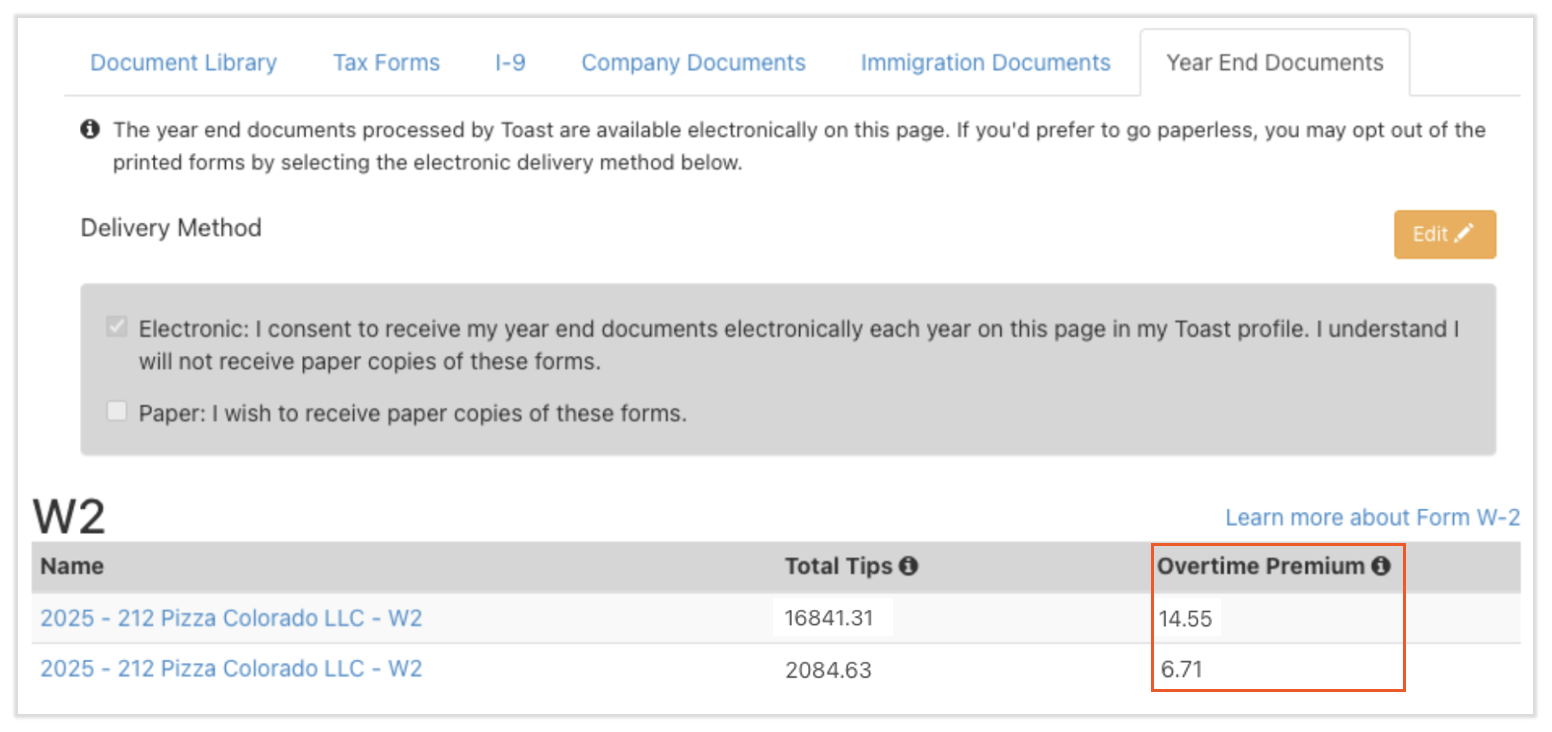
* Important note: This is an estimate, not a guaranteed or IRS-verified amount. The One Big Beautiful Bill applies only to federally-governed overtime (FLSA overtime), which is defined as hours worked over 40 in a workweek. For more information, refer to this IRA FAQ regarding qualified overtime.
If you work in a state with more generous overtime rules (such as daily overtime), the Toast Payroll estimate may be higher than the overtime premium allowed to be entered on your federal income tax return.
Toast Payroll Overtime Premium Amount in 2025
The overtime premium on your employee's profile represents an estimated overtime premium amount that may be used for your employee's personal tax filings. For 2025, Toast Payroll has calculated it by dividing an employee's total overtime earnings by three (3). This is because the legislation stipulates that only the premium portion of your overtime pay may qualify for tax deduction, not the full overtime earning amount.
Outlined another way, when an employee works overtime, it can be broken down as such:
- A portion that is Regular pay. This is the same rate an employee normally earns for regular hours.
- An additional "premium" amount required by state and federal law is the extra amount earned for working overtime. Typically, this is the extra 0.5x the regular pay rate, so that total overtime pay is 1.5x Regular pay. This premium can also be calculated at one-third of the overtime pay.
For example:
- An employee's regular rate of pay is $10/hour.
- Their overtime rate of pay at 1.5x Regular is $15/hour.
- The premium amount that may be entered on an employee's personal tax return is $5/hour. This is also one-third of $15 (15 / 3).
The One Big Beautiful Bill allows a tax deduction on the premium portion of overtime pay and not the full overtime pay. Because the premium portion is generally one-third of total overtime earnings, we show this estimate to help you understand your potential tax deduction amount.
Toast Payroll Overtime Premium Amount Starting in 2026
Starting with the 2026 Form W-2, which is issued in 2027, overtime premium amounts will be added to Form W-2s per IRS guidance.
To accommodate this change of IRS reporting requirements on Form W-2 in 2026, Toast Payroll will exclude non-federally-governed overtime from its reporting of overtime premium by subtracting 40 from hours worked per week. Those hours will be multiplied by the overtime rate and then divided by three to report the overtime premium amount on the Form W-2.
(Hours worked per week - 40) x Overtime rate / 3 = Reported overtime premium amount on the 2026-2028 Form W-2.
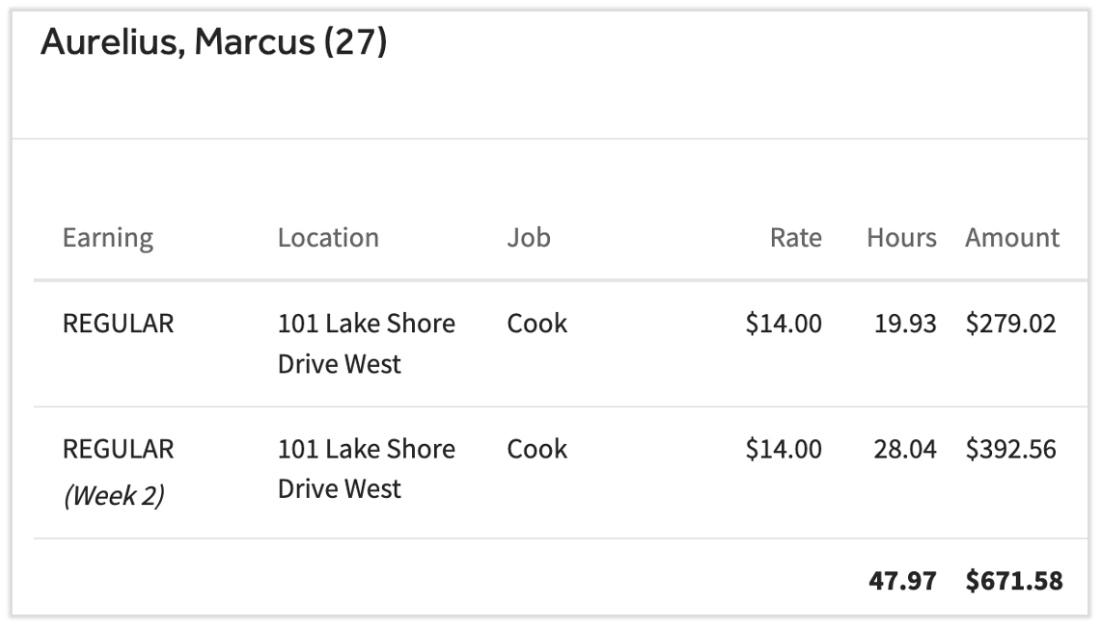
To be able to report this number, Toast Payroll will need to record hours worked by week. If you have a biweekly or semi-monthly check frequency, there is a change to 2026 payroll hours input: Employee hours will be listed by week rather than by pay period. You may notice changes to how employee hours are listed on the Employee Earnings step, on your payroll reports, and on employee pay stubs.
- When reporting by week, your tip makeup will also be shown by week rather than by pay period.
- If your pay group uses custom imports to add hours or tips to Toast Payroll, we strongly recommend using a per week template, even for biweekly and semi-monthly check frequencies. If you don't switch to a per week import template, there is a risk of inaccurate Form W-2 overtime premium reporting beginning in 2026.
Note: This updated changes how hours will appear on payroll reports and pay stubs. It does not change the amount of hours worked, the way in which overtime is calculated, or the rate at which employees are paid.
Example of an Employee Earnings step of payroll:
"No Tax on Tips"
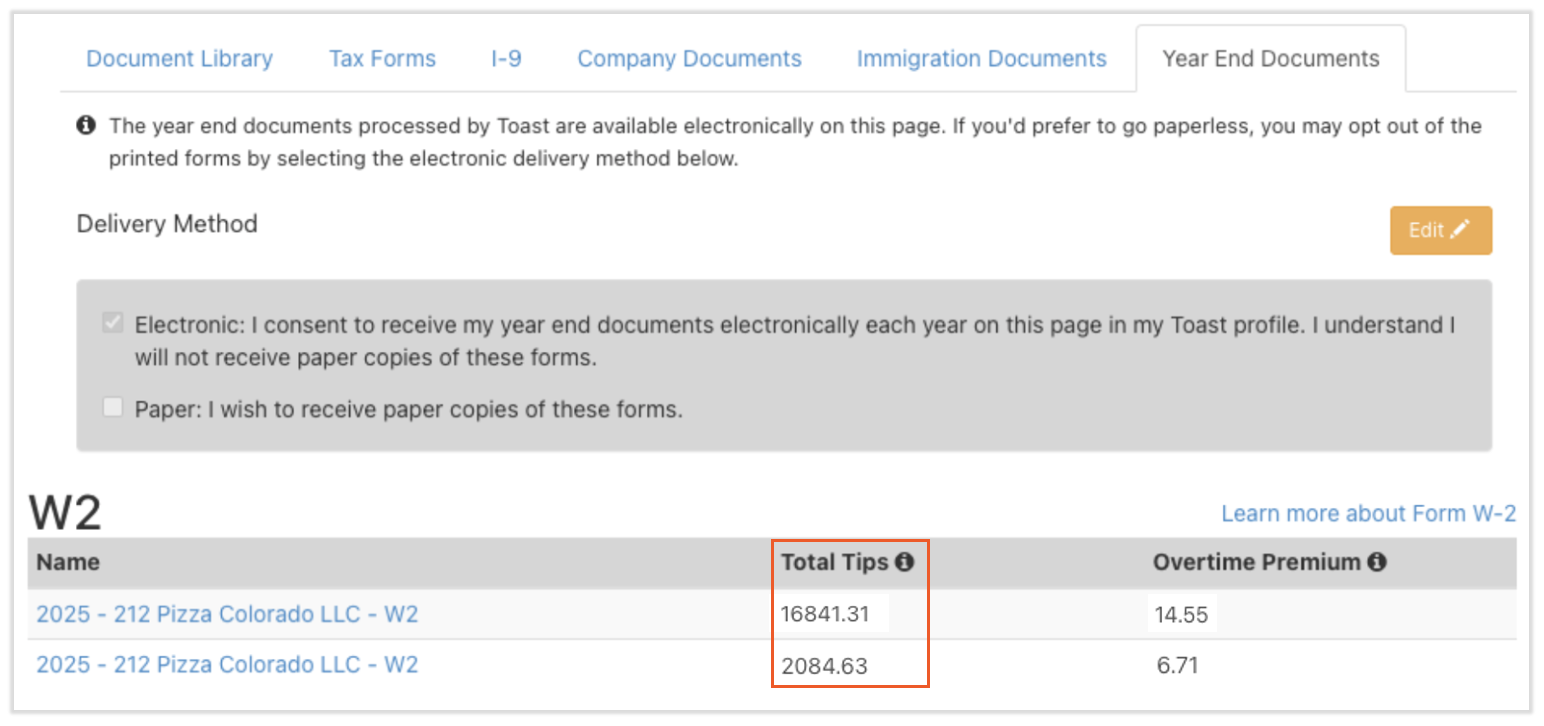
Tip amounts are the discretionary tips earned during the year as recorded in Toast Payroll. This includes both tips employees reported and any tips an employer was required to report on an employee's behalf. This is the same value that will appear on Form W-2 in box 7.
Employees can access their Form W-2 or their tip amount by logging into Toast Payroll and navigating to My Profile > Taxes & Documents > Year End Documents. (If you do not see My Profile on the left side of the screen, select Payroll from the Toast Web navigation rail on the left to make the Toast Payroll navigation rail appear.) The reported tip amount will be available beginning on January 19, 2026, when Form W-2s are available.
2026 Changes to Payroll Taxes
Updated Form W-4
The IRS recently released an updated Form W-4. Minor changes were made to some of the language on the 2026 Form W-4. These changes do not impact tax withholding calculations. The IRS has not yet mandated use of the updated form. Toast Payroll will work on updates to the form and make it available to employees in early 2026.
The only major updates were made to the IRS Deductions Worksheet, located on page 4 of the updated IRS Form W-4 documentation. The worksheet can assist employees in determining what they should enter on Form W-4. If an employee would like to adjust the amount of taxes withheld based on the 2026 W-4 worksheet, they can be entered on the currently-available Form W-4 in Toast Payroll.
If an employee is a non-resident, please review IRS Notice 1392 for special instructions concerning how to fill out your Federal W-4.
Treasury Tipped Occupation Codes (TTOC)
Treasury Tipped Occupation Codes (TTOC) are a list of proposed codes for classifying jobs that customarily and regularly receive tips. The proposed codes are correlated with Standard Occupation Codes (SOC).
TTOC are not required for 2025 reporting and are not on the 2025 Form W-2. Reporting will begin on the 2026 Form W-2. Toast Payroll will add TTOC to employee profiles in 2026.
This content is for informational purposes and is not intended as legal, tax, HR, or any other professional advice. Please contact an attorney or other professional for advice.